
AI alone isn't the answer. AI-driven Print ERP is.
17 November 2026
Everyone is talking about AI, Dataline is turning it into higher margins
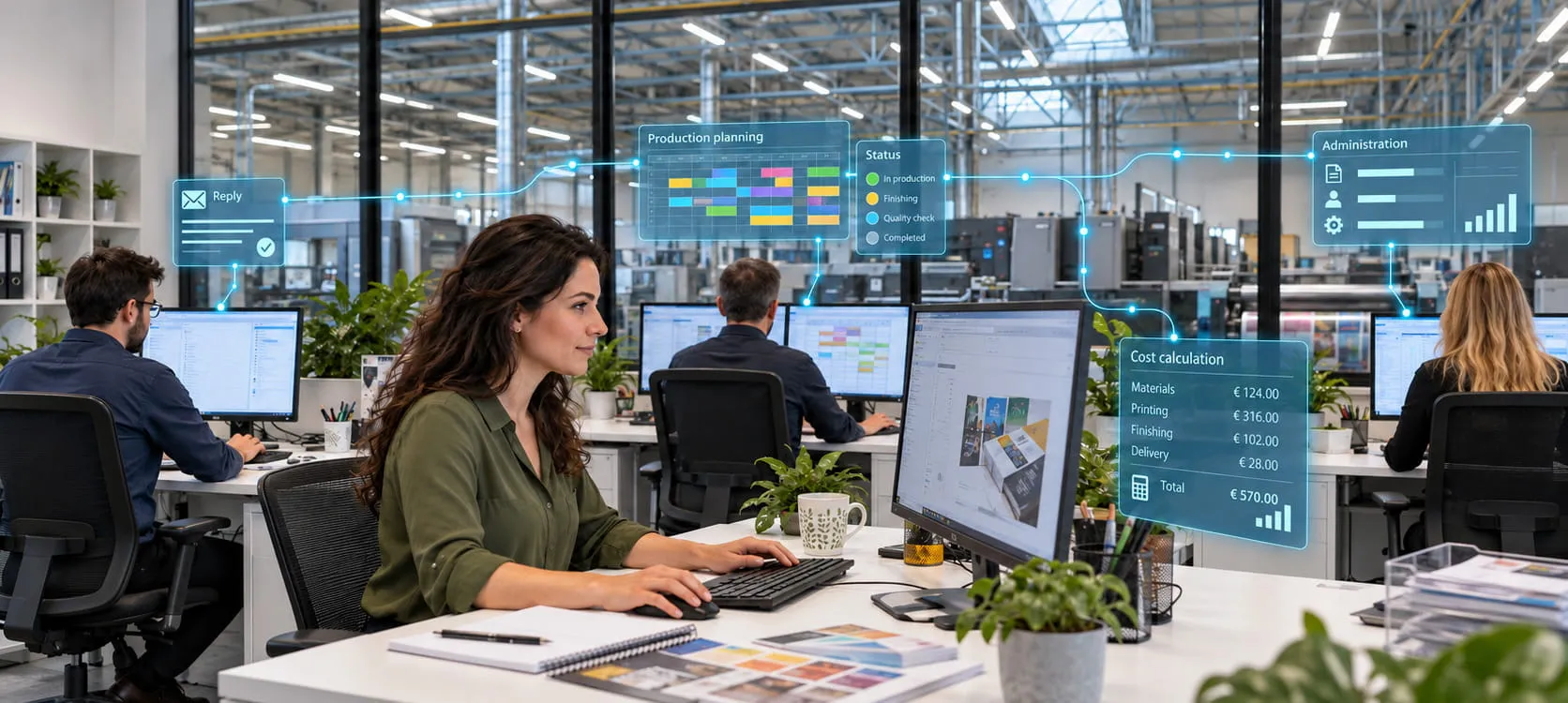
For years, the print industry has invested in faster presses, smarter finishing equipment and automated production lines. Yet according to Dirk Deroo, founder and CEO of Dataline, the biggest productivity gains in the years ahead will increasingly be found beyond the production floor. “The next big leap in efficiency will happen before and around your machines: in estimating, order processing, planning, administration and decision-making.”
This is becoming increasingly important as print runs get shorter, while the number of orders, product variations and customer expectations continues to grow. A small order often requires almost as much administrative work as a large one. Deroo calls this the invisible factory: all the processes, decisions and information flows involved before a job can be produced and eventually invoiced. This is where countless hours are still lost to emails, duplicate data entry, checks, handovers and searching for information.
“Our ambition is simple: we want to make the print industry more profitable. Not by making people work harder, but by letting software take on more of the work.”
Join the webinar
Want to learn more about automation and AI? Join the live webinar: From AI to ROI.
From managing data to running a smarter business
This is also what sets generic business software apart from specialised Print ERP. Print businesses deal with complex estimates involving countless production parameters, alternative production methods, short runs, changing materials and finishes, outsourcing, logistics and margins that vary from job to job. Only when this entire process is digitally connected can repetitive tasks be systematically automated.
Every repetitive administrative task that software can handle reliably should be handled by software, not by an employee. That does not mean taking people out of the process. Quite the opposite. It frees up their time to focus on exceptions, customers, creativity and decisions where their experience genuinely adds value.
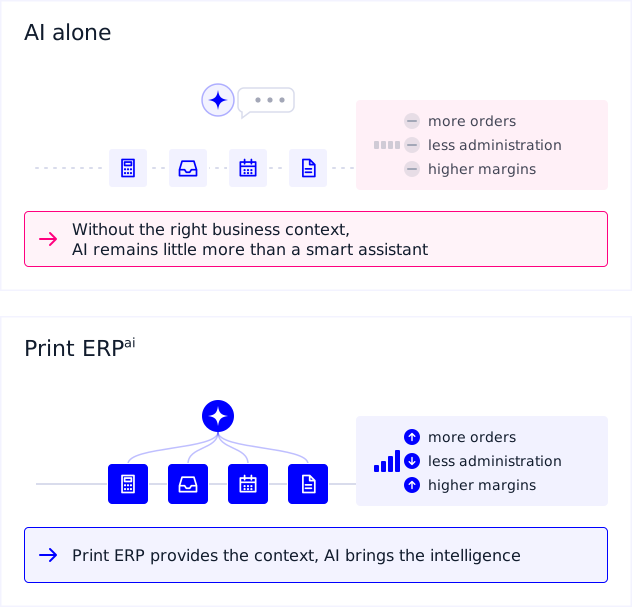
This also explains why Deroo believes AI alone is not the answer. “Without the right business context, AI remains little more than a smart assistant. Once AI has access to the data and processes of a specialised Print ERP system, it can start interpreting, predicting, making decisions and automating tasks.”
“Data is the new ink,” Deroo sums up. “Print businesses that get their data, processes and automation in order today are not just building a more efficient operation. They are laying the foundations for AI to deliver real returns tomorrow.”
Print ERP provides the context, AI brings the intelligence
“Every print job generates valuable data. Artificial intelligence can interpret that data, but it also needs context. That context comes from Print ERP. This is how Print ERP evolves from a system that manages your business into intelligence that helps your business become more profitable.”
Dataline brings this evolution together under one concept: Print ERPai. Rather than adding AI as a standalone tool on top of existing software, artificial intelligence is embedded directly into Print ERP, giving it a deep understanding of a print business's data, processes and production logic.
Dataline is putting this approach into practice across MultiPress, Unik, DigiFlex and VG Seven. The principle is the same throughout: connecting sales, estimating, order processing, production and administration so that more orders do not automatically mean more administrative work. Dataline's AI suite brings intelligence directly into each of these processes.
Estimaite interprets customer enquiries and turns them into ready-to-use quotations. Planmaite supports production planning by analysing capacity and identifying bottlenecks. Flowmaite extracts information from emails, instructions and other unstructured input, turning it into actions within ERP workflows. Einstain helps determine the most profitable production method for every print job, while Maike or Buy makes it easier to decide whether to produce in-house or outsource.
That is a fundamentally different approach from treating AI as a gimmick. AI becomes part of the invisible factory itself.
Our ambition is simple: we want to make the print industry more profitable. Not by making people work harder, but by letting software take on more of the work.
How can you make your invisible factory visible?
For Deroo, AI is just one part of a much broader transformation. In his book The Road Ahead in the Print & Sign Industry, he explores how shorter print runs, labour shortages, rising costs, automation, sustainability and data are reshaping the business models of print and sign companies. His aim is not to predict the industry's future, but to help businesses make their invisible factory visible today.
The most important question is not which AI application will become popular tomorrow. It is how much work people are still doing today that software could reliably take over. Because ultimately, Deroo believes technology should deliver visible results in just three areas: more orders, less administration and higher margins.
The printing presses of 2030 will undoubtedly be faster and smarter. But the future of print businesses may already be shaped long before those presses start running.


Read more
AI-driven Print ERP
Dataline brings artificial intelligence to your Print ERP: for even more automation, lower costs, smarter decisions and greater control over your margins.
The Road Ahead in the Print & Sign Industry
Data and AI will define the profit model of graphic companies in 2030. Discover the trends and prepare your print business for the future.
From AI to ROI for your print, sign and LFP business
Discover how Dataline's AI-powered Print ERP helps you prepare quotes faster, process more orders, streamline production and boost your profitability.