
While many print production companies are still wondering how to digitise, the winners of 2030 are already taking steps today to reduce their overheads, optimise their margins and maximise the value of their business. Dirk Deroo, CEO of Dataline: “Driven by data, artificial intelligence and advanced connectivity, print, sign and LFP companies will undergo a radical transformation in the coming years.”

The graphic industry is undergoing a period of profound change. This brings not only challenges, but also new opportunities to strategically position your print, sign and LFP business.
Based on current market insights, Dataline has developed a clear vision to support the print industry, with software solutions that enable graphic companies to anticipate many of the sector's challenges.
Let this be a wake-up call for entrepreneurs who want to win. Will you choose growth and greater control over your margins? Or will you stubbornly cling to yesterday’s workflow? You decide what your print, sign and LFP business will look like in 2030.
Those who do not digitise today will not just lose margin, but also their right to exist. By 2030, data and artificial intelligence will become the new ink in the printing sector. The player with the best algorithms wins. From now on, not automating is officially the most expensive decision you can make.
Dirk Deroo, CEO of Dataline, at FESPA Trend Event 2025
The road to 2030 is not defined by a single technology or a single decision, but by a series of strategic choices. Choices about people, data, automation, security and sustainability. Below, Dirk Deroo elaborates on four themes that are transforming the print industry towards 2030.
How do you remain profitable as labour costs continue to rise?
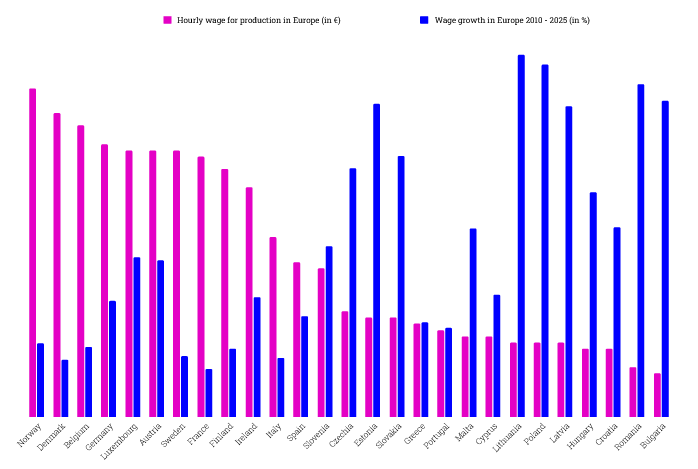
Rising labour costs are putting pressure on your profitability. Not because employees are too expensive, but because in many print, sign and LFP companies, they still spend too much time on repetitive tasks. In administration, prepress and sales, workflows often remain stuck in a way of working that no longer aligns with today’s reality: more orders, smaller print runs and greater complexity.
“When the number of orders increases, additional staff are still taken on, while the processes themselves hardly change,” says Dirk Deroo. “As a result, labour costs keep rising without productivity keeping pace.” That extra overhead becomes increasingly difficult to pass on, putting margins under pressure.
Remaining profitable therefore requires a different approach. Not by working harder or hiring more people, but by automating repetitive tasks and allowing staff to focus on work that adds more value. This is only possible if you have an objective view of how your organisation functions.
With the MAS audit software you gain better insight into where processes are slowing down and where optimisation is possible without additional staff. This enables you to make proactive adjustments and keep your organisation agile.
Why AI is the game-changer for the graphic industry?

Artificial intelligence is no longer a hype. You are probably already using it today, consciously or unconsciously. But the real difference is not made by using AI to write texts or speed up tasks. The real added value lies in how you use AI to make your graphic company work more intelligently.
Dirk Deroo: “The solution lies in data. AI is only as good as the information you feed it. Equally important is learning to critically assess the output. The basic rule still applies: garbage in is garbage out. The better your insight into your orders, quotes, margins, customers and production, the more effectively AI can support your business. Not to replace people, but to relieve them of manual tasks.”
In a modern MIS/ERP system, AI can already assist with daily operational decisions. Which route is most logical for delivering orders? In what order should you print the day's jobs, considering prepress and finishing? Should you produce a job in-house or outsource it? And what sales price gives you the greatest chance of winning the order with this client, without compromising your margin?
These are not future scenarios, but applications that are already available today. “AI does not replace people,” says Dirk Deroo. “AI takes away the repetitive burden that prevents people from really making a difference.” Graphic companies that use AI in this way make better decisions and build speed and scalability. Those who ignore AI or use it superficially are mostly missing out on opportunities.
How EU legislation also creates new opportunities?
EUDR, CSRD, CO₂ reporting… European regulations often cause frustration. Yet they do not need to be a brake on your business. On the contrary, those who handle regulations smartly can use them as a strategic advantage.
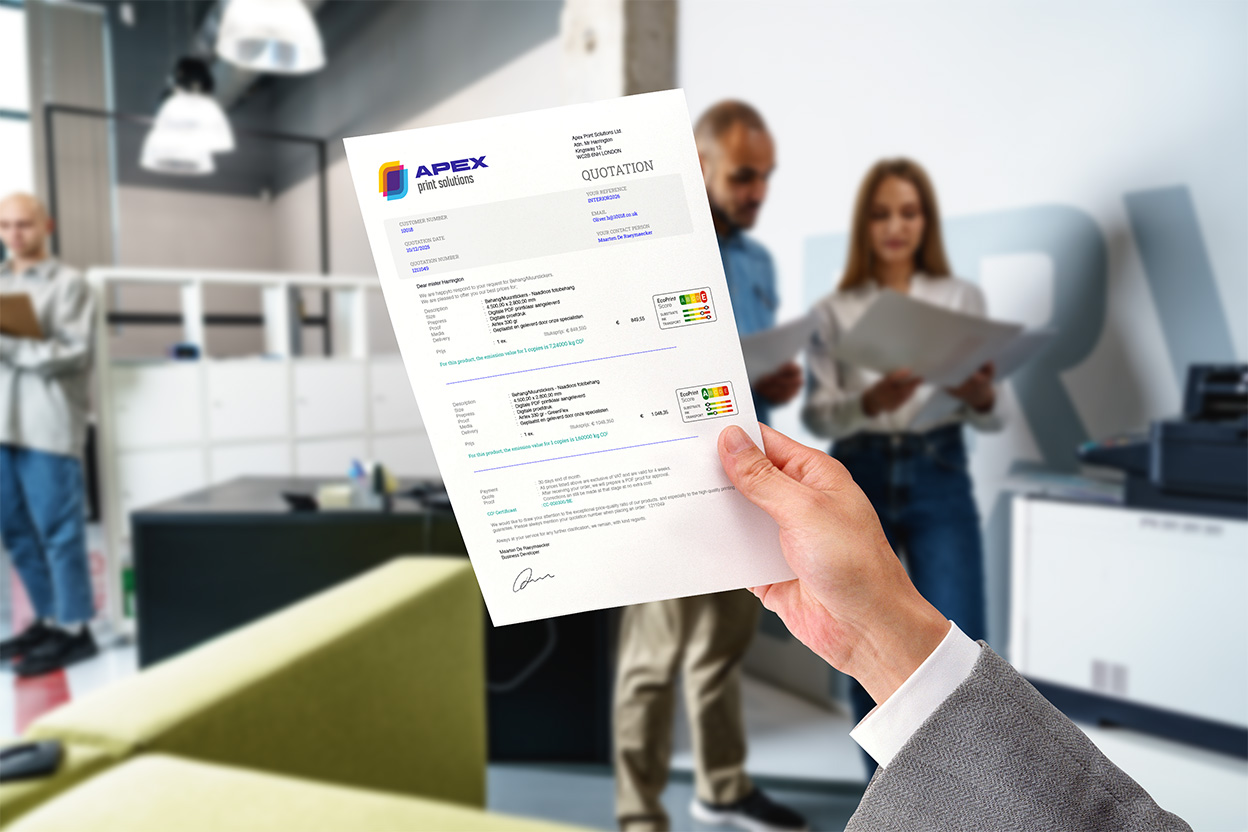
Take the obligation to calculate and report CO₂ emissions. Manually, that is a time-consuming and error-prone task. With the MultiPress CO2 Suite, you can add that information to a quote in just a few seconds. What initially seems like an administrative burden becomes a commercial asset.
Even though the reporting obligation currently applies mainly to large companies, the impact extends further. As soon as your client is required to report on their CO₂ emissions, they will also expect that information from their suppliers. Whether you like it or not, that question will land on your desk. That is precisely where the opportunity lies.
“If you have to calculate CO₂ emissions anyway, you might as well use it to create added value,” says Dirk Deroo. By offering alternatives with a better EcoPrint Score and a higher margin, you help your clients make more sustainable choices while increasing your own profitability. Sustainability and profitability do not have to be mutually exclusive. “Print, sign and LFP companies would do well not to see regulations as an obstacle, but as a lever.”
Why human-centric security is becoming increasingly important?

Cybersecurity is on the agenda of every print, sign and LFP company. Phishing, malware and data leaks are no longer abstract risks. The question is not if you will be affected, but when. Yet the greatest threat today often does not lie outside your organisation, but right in the middle of it.
“The biggest risks rarely come from outside your company,” explains Dirk Deroo. “They originate within your own walls.” Employees and former employees often have access to sensitive business data. During staff turnover, partnerships or acquisitions, that information can be taken, consciously or unconsciously. In practice, this happens more often than many entrepreneurs would like to admit.
Traditional cybersecurity is no longer sufficient. In addition to firewalls and backups, you also need to know who has access to which data, and what is being done with it. That is the essence of human-centric security: not only securing technology, but also including human behaviour in your security strategy.
At Dataline, you can integrate an Inside Leak Surveillance function into the software. This makes it possible, when data theft is suspected, to objectively record which data were exported or printed. Not to sow distrust, but to limit risks and, if necessary, act with legal backing.
Data is now one of the most valuable assets. In a sector where information is often widely accessible, human-centric security becomes crucial to protecting your business over the long term.
On the road to 2030, with Dataline as your automation partner
Progress starts with entrepreneurs who dare to look ahead, even when the future seems uncertain. “That is exactly where the biggest opportunities lie,” says Dirk Deroo. “Those who do not digitise today will lose not only margin tomorrow, but also their right to exist. By 2030, data and artificial intelligence will become the new ink in the printing sector. From now on, not automating is officially the most expensive decision you can make.”
Ready for a no-nonsense conversation about your business?