
WHY DO I HAVE THE FEELING THAT MY ERP DOESN’T FIT TO MY BUSINESS?
No company decision is made without thorough research into ‘return on investment’ (ROI). This is especially true in the graphic sector, where tight deadlines and tighter margins are the rule, rather than the exception. Article by Serge Clauss
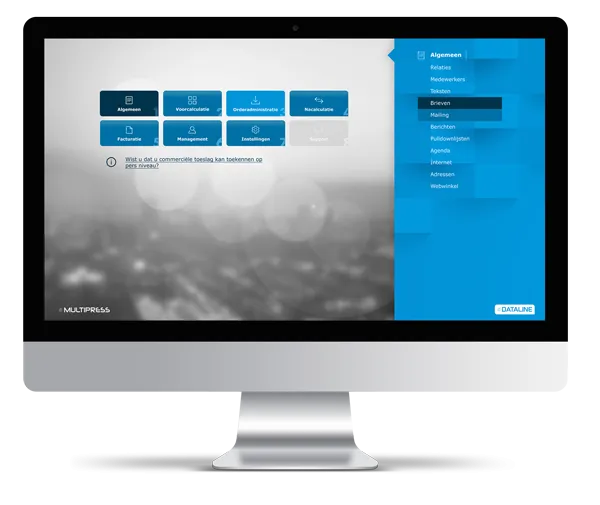
Is your current ERP good enough?
I’ve visited a significant number of printing companies across the world and seen highly ‘creative’ ERP solutions, but I’ve rarely seen print shop owners satisfied with their solution. Of course, reconsidering the way you’re managing your business is a major change, even a major challenge, but it is worth it.
You may believe your ERP is good enough, which is usually the case when you haven’t found a better solution. But, did you ever try to clearly identify your production steps?
Your ERP may look like this:
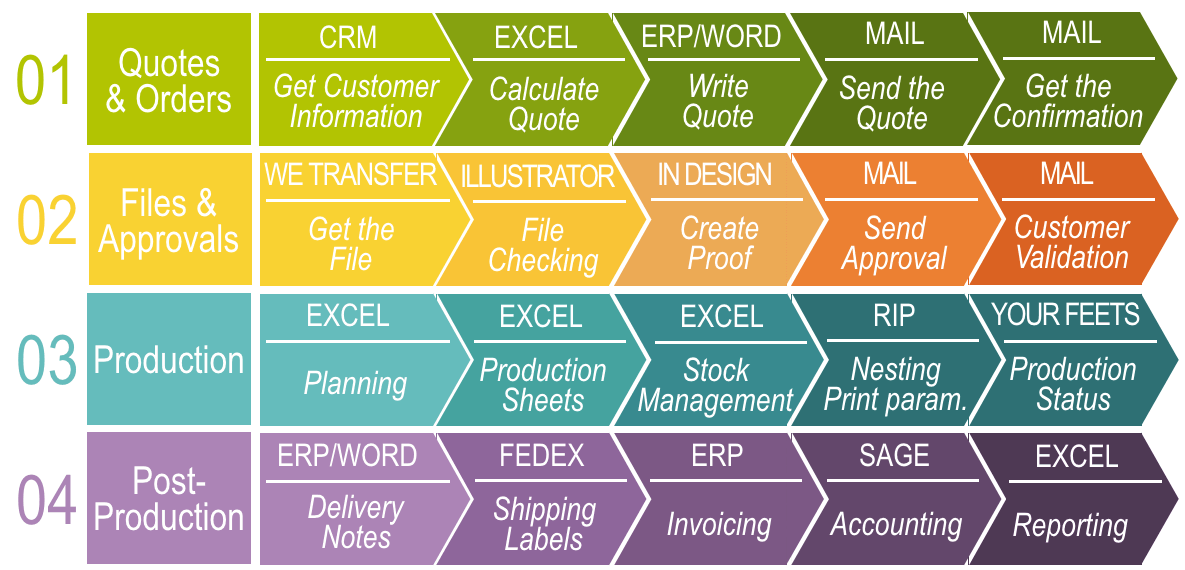
No, this is not good! Try to consider how many applications you must deal with and how much time you spend on each single step. Best case scenario: you’re just losing efficiency, but this may cost you much more in the end. This is what I call the ‘gray area’; you have no idea about how much it is costing you, but the customer will certainly not pay for it. Therefore, your production process needs to be traceable, automated and as smooth as possible.
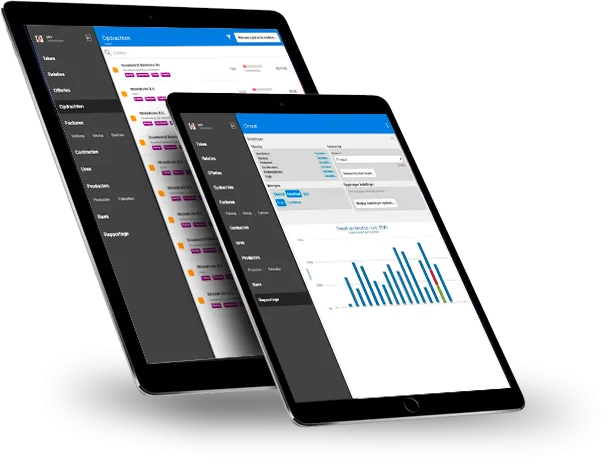
My 5 advices for a successful implementation
1 AUTOMATE YOUR TASKS
Validation process, file checking, nesting, stock management, accounting, connectivity with your production units... Eliminate as many manual and repetitive tasks as possible and, as a consequence, you’ll be able to get more jobs through production
2 LOOK AFTER AN INTEGRATED SOLUTION (market driven)
You’re not selling bicycles, and you need a solution that meets your requirements. Avoid generic solutions; they’ll never fulfill your needs. Look for a solution connected to your production environment.
3 INCREASE YOUR PROFITABILITY - AVOID RETYPING!
Reduce the ‘gray area’, optimize your process and minimize the number of applications you’re using. Never retype existing data. What has been entered once should be used along the production process.
4 DON’T PAY FOR UNNECESSARY MODULES
Assess your needs and requirements, and only choose the tools you need. You’ll always be able to add new modules once you need them.
5 INVOLVE YOUR TEAM
Decision-making processes, meetings and training are major factors behind the success of implementation. The acceptance factor is much higher if your team feels part of the project.
Undoubtedly, ERP systems are changing your habits, but you have to plan implementation stages. Try not to deploy everything at once and don’t underestimate education, training and support - they’re the foundations of crisis management

Have you ever tried to calculate your ROI??
To find out how much time and money you could save with MultiPress, try out the Dataline ROI Calculator.